The Application of Cold Heading in Micro Motors
Posted in 2026-08-25 17:04:51 in Tech Blog, 0 Comments
The smooth operation of a micro motor depends on the precise cooperation of countless tiny internal parts. Among them, key metal components such as shafts, housings, and gears not only bear the tasks of transmitting power and supporting structures, but also directly affect the motor’s vibration accuracy, lifespan, and reliability. These small yet precise metal parts are mostly produced using the cold heading process.
Principles of the Cold Heading Process
Cold heading is a metal forming process that exploits the plasticity of metals at room temperature. A metal rod or wire is placed into a die, and a strong impact or pressure forces the material to flow and redistribute within the die cavity, forming the desired shape in a single step.
Think of it as “metal sculpting at room temperature” – no heating, no cutting, just a powerful compressive force that makes the metal flow like dough into every corner of the die.
Cold heading is most commonly used to produce standard fasteners such as bolts, screws, and nuts. But its capabilities go far beyond that – in the field of micro motors, cold heading is playing an increasingly important role.
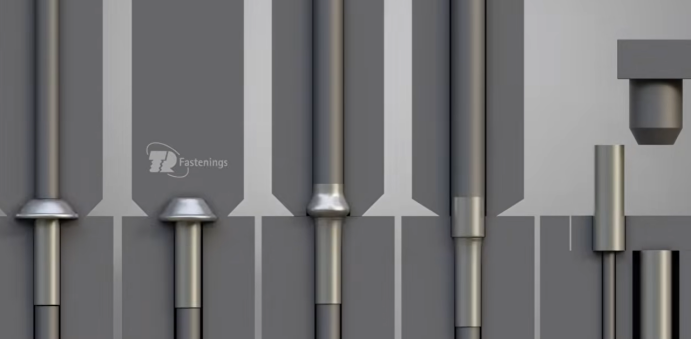
The Application of Cold Heading in Micro Motors
1. Motor Shaft
The motor shaft is one of the most critical parts of a micro motor. Traditional machining relies on multiple steps such as turning, milling, and grinding – many operations, low efficiency, and significant material waste.
Cold heading changes this picture. Using multi-stage cold heading technology, a cylindrical blank can be extruded at room temperature in a single blow, directly producing a motor shaft with high dimensional accuracy and good surface quality.
Even more noteworthy is that cold heading is a chipless machining method. Traditional turning generates a large amount of metal chips, with material utilization often only around 40 %. Cold heading, on the other hand, can achieve 85 %–95 % material utilization. This not only saves raw materials significantly but also eliminates the need for heat treatment and grinding, saving energy, lowering costs, and reducing environmental impact.
2. Micro Gears
Micro motors often require micro gears for speed reduction or power transmission. Cold heading can form gears with a module as small as 0.1 mm, with pitch diameters of only 1 mm and 2 mm respectively. Such tiny gears are almost impossible to produce by conventional cutting methods, yet cold heading can mass-produce them with high efficiency.
3. Housings and Structural Parts
Cold heading is also widely used in producing motor housings, copper terminals, heat sinks, and other electrical components. For micro motor housings, cold heading enables complex shapes to be formed in one blow, ensuring uniform wall thickness and consistent dimensions.
The Effect of Cold Heading on the Performance of Micro Motors
1. Higher Strength and Longer Lifespan
During cold heading, the metal’s grains elongate along the deformation direction, creating a work hardening effect. This gives cold-headed parts higher strength and better fatigue resistance compared to machined parts. For micro motors that must withstand high-frequency vibration over long periods, this means longer lifespan and better reliability.
2. Consistent Precision and Stable Performance
Cold heading relies on high-precision dies to ensure dimensional consistency from batch to batch. For micro motors, the clearance between shaft and bearing, and the meshing accuracy of gears, directly affect vibration quality and noise levels. Cold-headed parts have excellent dimensional uniformity, ensuring that thousands of motors deliver the same high performance.
3. Burr-Free and Quieter Operation
Cold-headed parts have smooth surfaces and are free of burrs. This is especially important for micro-gears – smooth tooth surfaces mean less impact and lower noise during meshing. Cold heading produces no cutting chips, which also avoids the problems of abnormal noise, uneven wear, and rotational losses that can be caused by residual chips.
4. Lightweight Design for Better Energy Efficiency
Cold heading can also produce lightweight structures such as hollow shafts. Hollow shafts reduce weight while maintaining sufficient strength, lowering energy losses and contributing to the overall efficiency of the micro motor.
The Boundaries of Cold Heading
In terms of precision, cold heading typically achieves tolerances of about ±0.1 mm, compared to CNC machining which can reach ±0.01 mm. Therefore, for mating surfaces that require extremely high precision, cold-headed parts may still need a small amount of finishing.
In terms of dimension, the length-to-diameter ratio of a cold-headed part is difficult to exceed 3:1. For particularly slender shafts, other processes or hybrid approaches may be required.
In terms of miniaturization limits, forming gears with a module smaller than 0.2 mm still faces challenges such as excessive die loads and operational difficulties.
Considering Baolong Company?
Email us at:
sales@baolong.com
Or call us at:
+86 (0577) 62572888